
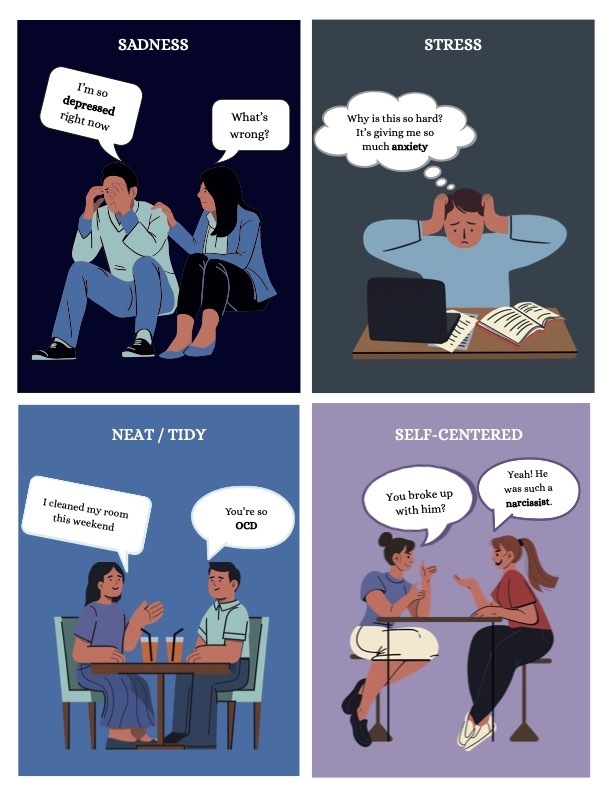
In today's world, a lot of people would consider being sad after a bad day as depression or being stressed after a long day at work as anxiety, using mental illness labels without a formal diagnosis. According to the Centers for Disease Control and Prevention, depression among teens and adults increased from 8.2% in 2013 to 13.1% in 2023, which shows that people are genuinely struggling with mental health issues. However, experts worry that this has led to a problem where people treat those illnesses as personality traits, which blurs the lines between genuine illness and daily hardships.
Having a mental illness is not a situational moment that lasts for a certain number of days. Although the symptoms are similar, such as stress and anxiety, they don't immediately confirm that someone has a mental illness unless they have a formal diagnosis from a professional. According to the American Psychiatric Association, each disorder has a set of diagnostic criteria that indicate the symptoms that must be present and for how long to qualify for a particular diagnosis, and these criteria are meant to be used by trained professionals using clinical judgment. Mental illnesses don't just affect people's minds but their lives and ability to function as well.
"If you have some type of disorder in mental health, you have been dealing with it for a long time, and a lot of times it's taking over a part of your life that you feel like you don't have much control over anymore,” Warren Central counselor Nicole Raber said.
One of the main reasons people might misuse mental health labels is to describe everyday emotions and behaviors. A tidy person is described as having obsessive-compulsive disorder (OCD), and a moody person is called bipolar.
Junior Marco Sanchez, goalkeeper of the school soccer team, admits that labels are often used to describe temporary stress.
“I don’t have anxiety in general, but whenever there’s a big match, every player gets nervous,” Sanchez said.
Other times, self-diagnoses come from a lack of understanding. Someone may have heard the word somewhere and is using it without knowing the realities of living with that illness. Someone with real OCD experiences repetitive thoughts and behaviors, which can lead to anxiety and affect their ability to function. A person diagnosed with bipolar disorder experiences more than simple moodiness. They have depressive episodes and manic episodes that affect almost every area of their lives. What most people don't realize when using those labels, experts say, is that they might be spreading more stigma around mental illness.
Throughout history, there has always been stigma around mental health, which has made most people afraid to share their issues. According to many mental health advocacy groups such as the National Alliance on Mental Health, while efforts to fight the stigma have grown over the years, social media has played a huge role in normalizing mental conversations among people. It has helped people feel less alone and more willing to get help. According to the American Psychological Association, 74.25% out of 400 TikTok posts analyzed under mental health hashtags described a personal experience of mental illness. COVID-19 acted as a catalyst, with widespread pandemic stressors like isolation and financial worry leading people to have even more open conversations about their mental health.
Though social media has been seen as helpful in normalizing conversations about mental health, it has also led to people self-diagnosing themselves simply based on what they see online. According to Education Week, 55% of high school students have used social media to diagnose their own mental health conditions at least once. While self-education about those topics is important and encouraged, it is not a confirmation of a mental illness unless it comes from a professional, not from a 30-second video with mental health hashtags.
"You're going to want to go to the National Mental Health Institute or something like that to be able to get your information," Raber said in regard to people who may have questions about their own mental health. "Educate yourself, see if it's something that I'm checking off the boxes, and I'm seeing that maybe this is something that I'm dealing with, then go to that trusted adult."
When mental health labels are misused, it doesn't just affect one person. It can affect everyone who genuinely struggles with those conditions.
“I think it might make people who struggle with it seem maybe undermined because it becomes seen as normal,” junior Ayesha Tabb said.
Raber explained that misusing these labels may also contribute to more stereotypes surrounding those who live with a mental illness.
In some cases, this misunderstanding can also lead individuals to seek unnecessary medication and spend money on treatments they don’t need. According to the National Institute of Mental Health, only half of people with mental illnesses receive treatment, which means that there are still many people not getting the help they need. And when mental health labels are casually tossed into normal conversations, it's harder for those individuals to be taken seriously. Sanchez has seen this played out when mental health is used for convenience rather than a real illness.
“Sometimes in the soccer team, people will use excuses not to do any kind of conditioning or just in general anything the coach asks them to do,” Sanchez said.
Mental illnesses are more than personality traits and daily discomforts. They are medical issues that affect every area of a person’s life. Though social media has helped in normalizing conversations about mental health, it has also made it easier for the terms to be used too loosely, which often overshadows the realities of having those conditions. Maintaining mental health involves more than labeling emotions; it requires ongoing awareness and care.
"Good mental health is like anything else," Raber said. "You've got to take care of your body to be healthy, and you have to take care of your mind to be healthy."